Call today
382-6366
American Cockroach
Other Name(s): Cockroach
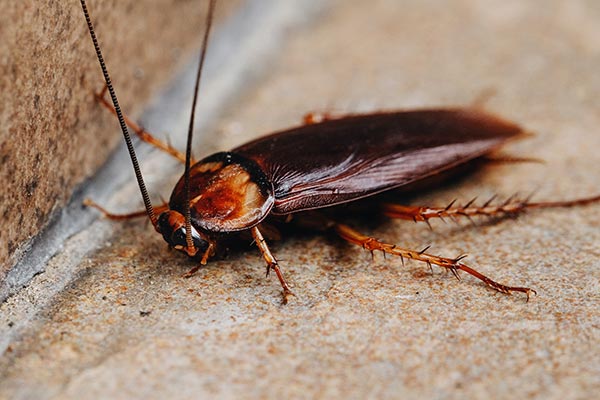
Characteristics: The American Cockroach is actually not native to
the United States, instead transplanted through hundreds of years of
shipping cargo and passengers across the oceans. They appear glossy
and carry a reddish-brown look throughout. Even their wings are the
same color and brown marks can be seen at the center of the pronotum.
The female has a shorter pair of wings wings while the male's extends
past the abdomen. They are surprisingly very good flyers.
General Adult Size (Length):
27mm to 40mm (1.06in to 1.57in)
Identifying Colors: brown; red; yellow
Category: Cockroach
Common Name: American Cockroach
Scientific Name: (Periplaneta American)
Argentine ant (Iridomyrmex humilis)
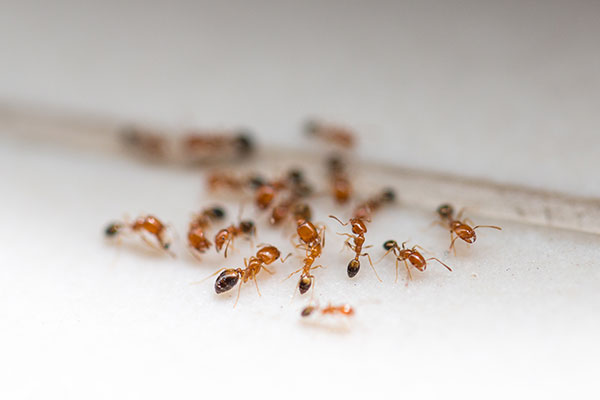
It is a small, dark-colored ant about 3 mm (1/8 inch) long that invades homes in search
of food and water. They are especially fond of sweets, but will feed on practically any
food. They love the yolks of hard boiled eggs and carry minute yellow clumps of yolk
back to their nest in endless ant columns. These ants are extremely well adapted to
urbanized areas of the United States with mild climates and well-watered gardens. They
pose a serious threat to native wildlife by upsetting delicate food webs. They are
especially formidable due to their aggressive behavior and the enormous size of their
colonies which can literally "team up" with other colonies.
They follow a pre-marked pheromone "scent" trail initially laid down by scouts who
were searching for goodies in your pantry. Although they prefer the outdoor life style,
they primarily enter houses for food and water. They are fond of sweets, tuna, syrups
(even cough syrup), juices, eggs, dead spiders and rodents, vomit, feces and just about
any other organic matter they can find. They are essentially scavengers and they play a
valuable role in the natural ecosystem--but preferably in Argentina. In hot, dry weather
they often search your home for water, including bathroom faucets and drains.
They are very aggressive and readily overtake other ant species, even ants that are much
larger and with powerful stings. Argentine ants are relentless and simply outnumber their
adversaries until the enemy colony is destroyed.
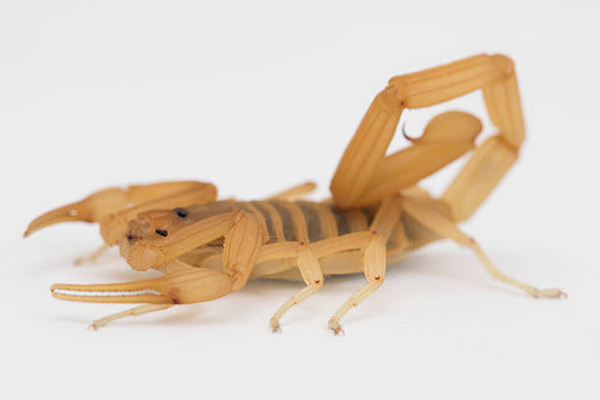
Bark Scorpion
The Bark scorpion is nocturnal, prefers to ambush its prey, and usually feeds on crickets and roaches.
With the influx of
trees and vegestation being brought in from Arizona, Southern Nevada now has a varried population of the Arizona Bark
scorpion.
Predators
Bark scorpions are eaten by a wide variety of animals such as birds, reptiles, and other invertebrates. Some examples
include spiders, snakes, peccaries, rodents, and other scorpions
Life cycle
Arizona bark scorpions have a gestation period of several months, are born live, and are gently guided onto their
mother's back. The female usually gives birth to between 25-35 young, and the young will remain with their mother until
their first molt, up to 3 weeks after birth. Arizona bark scorpions may live up to 6 years.
While nearly all scorpions are solitary, the Arizona bark scorpion is a rare exception: during winter, packs of 20 to 30
scorpions can congregate.
Bark scorpions, like most other scorpions, are incredibly resilient. Lab experiments have frozen the scorpions for weeks,
and after being thawed, the scorpions emerged unharmed. During US nuclear testing, scorpions, along with cockroaches
and lizards, were found near ground zero with no recorded adverse effects.
Habitat
The bark scorpion is particularly well adapted to the desert: layers of fat on its exoskeleton make it resistant to water
loss. Nevertheless, bark scorpions hide during the heat of the day, typically under rocks, wood piles, or tree bark. Bark
scorpions do not burrow, and are commonly found in homes, requiring only 1/16th of an inch for entry.
Arizona bark scorpions prefer riparian areas with mesquite, cottonwood, and sycamore groves, all of which have
sufficient moisture and humidity to support insects and other prey species. The popularity of irrigated lawns, and other
systems which increase environmental humidity in residential areas, has led to an explosion in the number of these
animals in some areas. It needs only a crack of 1/16 inch to enter a home.
Centuroides scorpions are unusual in that they are the only genus in the southwest that can climb walls, trees, and other
objects with a sufficiently rough surface. Bark scorpions practice negative geotaxis, preferring an upside down
orientation, which often results in people being stung due to the scorpion being on the underside of an object.
Venom
The bark scorpion is the most venomous scorpion in North America, and its venom can cause severe pain (coupled with
numbness and tingling) in adult humans, typically lasting between 24 to 72 hours. Temporary dysfunction in the area
stung is common; e.g. a hand or possibly arm can be immobilized or experience convulsions. It also may cause the loss
of breath for a short period of time. Due to the extreme pain induced, many victims describe sensations of electrical jolts
after envenomation.
In Mexico, more than 100,000 people are stung annually.
First aid
Basic first aid measures can be used to help remediate scorpion stings:
Clean sting site with soap and water. Apply a cool compress (cool cloth, no ice) Take acetaminophen(paracetamol) or
ibuprofen for local pain and swelling. Natural remedies include using the pulp from the prickly pear cactus on the sting
site.
Medical emergencies
Since the amount of venom the scorpion injects on a sting varies, Nevada poison control centers suggest immediate
medical attention only in the event of extreme pain or stings involving children.
UV lighting
Bark scorpions, like most other scorpions, will glow when exposed to a blacklight. This is particularly useful in scorpion
detection, since bark scorpions are active during the night, and can be easily spotted using this method. Typical UV LED
flashlights are able to readily detect scorpions at a distance of approximately 6 feet. Newly molted scorpions will not
glow under UV light for a few days after molting.
Bed
Bug
Characteristics: The body is flat, rusty red color -
sometimes purple or even brown (red after feeding).
Sizes range from 4mm to 6mm. Antennae are present
and appear quite slender and segmented. Short stubby
legs compliment the short - almost unseen - stubby
wings. Bed Bugs enjoy the warmth and constant food
supply that mammal hosts offer. They suck the blood out
from their host to achieve adulthood. Bed Bugs can
survive without food for up to 12 to 15 months and their
bites have not been confirmed as carriers of diseases.
Their bites do, however, cause bumps or swelling and
people are known to have allergic reactions to these
bites.
General Adult Size (Length):
4mm to 6mm (0.16in to 0.24in)
Identifying Colors: red; brown; purple
Category: True Bug
Common Name: Bed Bug
Scientific Name: (Cimex lectularius)
Black Widow
Other Name(s): Black Widow
Characteristics: Female Black Widows are well-known and particularly feared for their
venomous bites. They are shiney in look and feature a red hour-glass shape on their abdomen
(sometimes appearing as two red marks). The male is smaller than the female and is brown in
color with white markings on the sides of the abdomen and longer legs than the female. The
female will eventually immobilize and kill her mate. Baby Black Widow spiders will appear
orange-to-brown in color.
Though they bite, Black Widows generally tend to avoid human contact altogether preferring the
saftey of their webs instead. As with the Brown Recluse spider, should you even suspect a bite
from a Black Widow Spider, seek medical attention as soon as possible. Black Widow venom is
EXTREMELY poisonous to humans. Male Black Widow Spiders do not produce this venomous
bite.
General Adult Size (Length):
3mm to 10mm (0.12in to 0.39in)
Identifying Colors: white, red, black, orange, brown
Category: Spider
Common Name: Southern Black Widow
Scientific Name: (Latrodectus mactans)
Desert Tarantula
Characteristics: Desert Tarantulas are a common sight in
the Southwestern states. They generally hide during the day,
choosing instead to rest under rock collections or in
protective holed burrows that are uninhabited in desert soil
areas until dusk and night. As with most insect species, the
male of the species is smaller though Desert Tarantulas in
general are noted for their leg spans which can reach up to 4
inches on the females. Their bodies are also covered in
noticeable hair. This spider will work hard at avoiding contact
with people but will strike if disturbed or threatened. It
should be noted that Desert Tarantula bites are considered to
be poisonous and seeking medical assistance is advisable. In
general, Desert Tarantula venom is reported to be about as
dangerous as a bee sting but deadly allergic reactions may
result.
General Adult Size (Length):
50mm to 70mm (1.97in to 2.76in)
Identifying Colors: gray, brown, black
Category: Spider
Common Name: Desert Tarantula
Scientific Name: (Aphonopelma chalcodes)
Desert Tarantula
Characteristics: Desert Tarantulas are a common sight in the Southwestern
states. They generally hide during the day, choosing instead to rest under rock
collections or in protective holed burrows that are uninhabited in desert soil areas
until dusk and night. As with most insect species, the male of the species is
smaller though Desert Tarantulas in general are noted for their leg spans which
can reach up to 4 inches on the females. Their bodies are also covered in
noticeable hair. This spider will work hard at avoiding contact with people but will
strike if disturbed or threatened. It should be noted that Desert Tarantula bites are
considered to be poisonous and seeking medical assistance is advisable. In
general, Desert Tarantula venom is reported to be about as dangerous as a bee
sting but deadly allergic reactions may result.
General Adult Size (Length):
50mm to 70mm (1.97in to 2.76in)
Identifying Colors: gray, brown, black
Category: Spider
Common Name: Desert Tarantula
Scientific Name: (Aphonopelma chalcodes)
European Earwig
Other Name(s): Earwig
Characteristics: Contrary to popular belief, earwigs do NOT crawl into
human ears and bite or pinch people. In fact, earwigs are harmless.
Their pincers are formidable in defense against other earwigs (males
fighting for females) or predators. The pincers also help the earwig fold
its wings closed.
They have wings, but rarely fly.
Adults of this species hide under objects by day. They are considered
beneficial in gardens because they eat aphids. If prey is scarce though,
they may damage flower blossoms of fruits and vegetables, making
themselves more of a pest.
General Adult Size (Length):
9mm to 17mm (0.35in to 0.67in)
Identifying Colors: brown; yellow; red; orange
Category: Earwig
Common Name: European Earwig
Scientific Name: (Forficula auricularia)
German Cockroach
Other Name(s): Croton bug
Characteristics: Smaller than American and Oriental
cockroaches, German cockroaches are notorious household
pests.
Infesting houses, restaurants and other institutions with food
pantries, they come out at night or in the dark, scavenging
for whatever they can find.
They hide behind stoves and under sinks during the day, but
if actively scavenging in daylight, severe infestation is likely.
Several generations can be born in one year, with
approximately 30 nymphs in every egg capsule.
Adhesive pads allow it to walk vertically on smooth surfaces,
even glass.
The name "Croton bug" was coined in the late 1800's when
they first began invading homes in New York after the Croton
Resevoir started bringing additional water to the growing city.
General Adult Size (Length):
13mm to 16mm (0.51in to 0.63in)
Identifying Colors: brown; black
Category: Cockroach
Common Name: German Cockroach
Scientific Name: (Blattella germanica)
Honey Bees
Characteristics: Honey Bees break down into two classes,
the worker bees (numbering up to 80,000 in a single nest)
and the Queen Bee.
Working bees feature a nearly all-black head with a body
coloring of golden brown and black with patches of a dull
orange. Yellow bands are easily distinguishable on the
abdomen and wings are clear. Their entire bodies are
covered in tiny hairs with these being most notable on the
head an body.
They are found throughout the United States and are also
bred commercially. Currently, honey bee populations are
disappearing from commercial hives for unknown reasons.
Entomologists call this anomaly CCD, or Colony Collapse
Disorder. Honey bees are a super-pollinator for all fruits and
vegetables grown for human consumption and a limited
number of them can directly effect how much produce is
harvested.
They originated as transplants from New World colonists
coming to America. Workers measure between 9 and 18mm
while queens cover some 18 to 20mm in length.
General Adult Size (Length):
9mm to 20mm (0.35in to 0.79in)
Identifying Colors: red, brown, black, orange, yellow
Category: Bee, Ant, Wasp and Similar
Common Name: Honey Bee
Scientific Name: (Apis mellifera)
Johnson Jumping Spider
Other Name(s): Red Jumping Spider
Characteristics: These tiny spiders jump large distances
(considering their size) to catch their prey. They are day-
time hunters and hide out at night and in the winter.
They have been known to bite humans, but without serious
effects.
Females weave funnel-shaped webs to lay eggs in under
rocks or between objects. Males have an abdomen that is
completely red, whereas the female will have a black line
down the center of her abdomen.
General Adult Size (Length):
7mm to 13mm (0.28in to 0.51in)
Identifying Colors: black; red; white
Category: Spider
Common Name: Johnson Jumping Spider
Scientific Name: (Phidippys johnsoni)
Orb Weaver
Other Name(s): Orb Weaver
Characteristics: Orb Weavers come in a variety of shapes and sizes.
Common traits among some include the rounded abdomen and
orange-to-brown and brown or black coloring - those this colors may
vary per species. Legs of an Orb Weaver are generally very long,
giving it a most menacing look, and their overall body size can range
from 6mm for males and up to 10mm to 20mm for the females.
Habitats can range from grass to corners of homes or under protected
porches. Their webs are clearly their operating stage as the Orb
Weaver sits in the middle, head facing downwards, waiting for prey to
come upon their net. If the spider is not found in the middle of the
web, it is usually nearby monitoring the web by way of a "signal" line
still attached to the spider. The moment a prey gets entangled in the
sticky web, the spider can come out to finish the job.
It is reported that Orb Weavers will re-spin a new web every night.
Their proficiency at nighttime hunting and propensity to enjoy insects
makes them the ultimate in the way of mosquito zappers. If you find
an Orb Weaver near your front door or deck, and it is not in an
intimidating area for you or your guests, keep it around and you'll
notice the mosquito population dwindle in the dusk-to-nighttime
hours.
General Adult Size (Length):
6mm to 20mm (0.24in to 0.79in)
Identifying Colors: orange, brown, yellow, black
Category: Spider
Common Name: Orb Weaver
Scientific Name: (Araneus spp.)
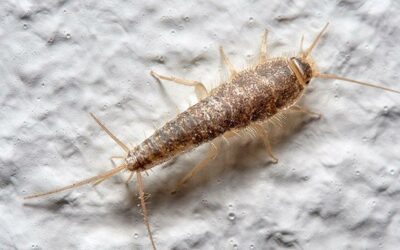
Silverfish
Characteristics: These little pests can be found in the dark warm places of the
home. They have a very unique tapered shape and can appear to be very flat. The
most noticeable feature of the Silverfish besides their color of silver is the three tails
found at rear.
Silverfish are drawn to the dry starchy substances commonly found in pantries. This
explains why they might also be found in the pages of old stored books as the printing
material used in these items (also found in magazines) becomes a food source to the
wandering Silverfish. Amazingly, Silverfish can live for months without eating.
Silverfish bodies are covered with flexible and slippery scales that protect the insect
from capture from larger insects such as spider. This body covering also allows them
to neatly fit within the pages of a closed book and feed. General length of these
creatures comes in at about 9mm to 13mm in total length.
Another interesting facet about these critters is in the time that they take to mature.
Southern Silverfish can see adulthood in 24 months whereas Northern-based
Silverfish will take longer. No doubt this is due to the warmer temperatures commonly
found in the Southern states.
General Adult Size (Length):
10mm to 12mm (0.39in to 0.47in)
Identifying Colors: silver, gray
Category: Bristletail
Common Name: Silverfish
Scientific Name: (Lepisma saccharina)
Termites
Termites are small, white, tan, or black insects that can cause severe destruction to wooden structures.
Termites belong to the insect order Isoptera, an ancient insect group that dates back more than 100
million years
Termites become a problem when they consume structural lumber. Each year thousands of housing
units in the United States require treatment for the control of termites. Termites may also damage
utility poles and other wooden structures. These pests cause serious damage to wooden structures and
posts and may also attack stored food, books, and household furniture.
IDENTIFICATION
Termites are social and can form large nests or colonies. Physically the largest individual is the queen.
Her function is to lay eggs, sometimes thousands in a single day. A king is always by her side. Other
individuals have large heads with powerful jaws, or a bulblike head that squirts liquid. These
individuals are called soldiers. But the largest group of termites in a colony is the workers. While
other species of social insects have workers, termites are unique among insects in that workers can be
male or female. Surprisingly, termites can be long-lived: queens and kings can live for decades while
individual workers can survive for several years.
Signs of termite infestation include swarming of winged forms in fall and spring and evidence of
tunneling in wood.
There are more than 2,500 different types of termites in the world, however, most of this diversity can
be lumped into four distinct groups: dampwood, drywood, subterranean, and mound builders.
Termites are sometimes confused with winged forms of ants, which also leave their underground
nests in large numbers to establish new colonies and swarm in a manner similar to that of
reproductive stages of termites
The Nevada dampwood termite, Zootermopsis nevadensis, occurs in the higher, drier mountainous
areas of the Sierras where it is an occasional pest in mountain cabins and other forest structures; it
also occurs along the northern California coast. Winged reproductives are dark brown with brown
wings. Soldiers have a flattened brown or yellowish brown head with elongated black or dark brown
mandibles. Nymphs are cream colored with a characteristic spotted abdominal pattern caused by food
in their intestines. Nevada dampwood termites are slightly smaller and darker than the Pacific
species; reproductives are about 3/4 inch long.
Drywood Termites
Drywood termites infest dry, undecayed wood, including structural lumber as well as dead limbs of
native trees and shade and orchard trees, utility poles, posts, and lumber in storage. Drywood termites
are most prevalent in southern California (including the desert areas), but also occur along most
coastal regions and in the Central Valley.
LIFE CYCLE
Most termite species swarm in late summer or fall, although spring swarms are not uncommon for
subterranean and drywood termites. New kings and queens are winged during their early adult life but
lose their wings after dispersing from their original colony. An infestation begins when a mated pair
finds a suitable nesting site near or in wood and constructs a small chamber, which they enter and
seal. Soon afterward, the female begins egg laying, and both the king and queen feed the young on
predigested food until they are able to feed themselves. Most species of termites have microscopic,
one-celled animals called protozoa within their intestines that help in converting wood (cellulose)
into food for the colony.
Tick
Characteristics: Ticks are parasites that feed off the blood of a
host. As they feed, they release anticoagulants, chemicals that
prevent blood from clotting (stopping).
There are many species of ticks, some which spread disease to
humans (Lyme disease, Rocky Mountain Spotted Fever).
Ticks are not bugs, they are arachnids, which means they have 8
legs. Some ticks are round (like beans) while others are flat with
festoons (folds that look like a ridge) around their abdomen.
General Adult Size (Length):
3mm to 5mm (0.12in to 0.20in)
Identifying Colors: black; brown; orange; red; yellow; pink
Category: Mite or Tick
Common Name: Tick
Scientific Name: (Ixodes sp.)
Windscorpion
Characteristics: Windscorpions hide in burrows during the day and come
out at night and hunt other arachnids as well as insects. They are native to
dry, arid regions (deserts).
They cut up their prey with large pincers (chelicerae)that resemble fangs.
They run in a zig-zag pattern, scowering the ground for prey.
Males are smaller than females, but have longer legs. Males are extremely
fast and move like the wind (hence their name).
Windscorpions look more dangerous than they really are. They do not
produce vemon and only bite if handled.
General Adult Size (Length):
22mm to 32mm (0.87in to 1.26in)
Identifying Colors: brown; yellow
Category: Windscorpion
Common Name: Pale Windscorpion
Scientific Name: (Eremobates pallipes)
Yellow Jacket
Characteristics: Yellow Jackets are easily distinguishable by their yellow and
black coloring. Measuring in length from 12mm to about 16mm, the Yellow
Jacket is a common sight throughout all of North America. These flyers are
commonly found along the edges of forests and can make their hives nearer
the ground than in trees like other wasps might do.
Adult Yellow Jackets will feed off of nectar while other adults pre-chew insects
for consumption by the larva. A pregnant female will begin next construction
in the spring, bringing about the first generation of Yellow Jacket for the year.
Females from this brood will become hive workers and tend to the other
young presented later. By the fall - or when cold weather begins to make its
appearance - the males of the next will die off leaving only other mated
females to continue generations the following year.
Yellow Jackets, particularly the females, are extremely aggressive and will
sting repeatedly so avoidance is the best policy! Though avoidance is not
always possible, do not swing at the Yellow Jacket as they can be easily
provoked to attack.
An Eastern (V. maculifrons) and Western (V. pennsylvanica) species of Yellow
Jacket exist with few variations in the yellow and black coloring.
General Adult Size (Length):
12mm to 16mm (0.47in to 0.63in)
Identifying Colors: yellow, black, white
Category: Bee, Ant, Wasp and Similar
Common Name: Yellow Jacket
Scientific Name: (Vespula spp.)
House Mouse
The House Mouse (Mus musculus) is a small rodent, a mouse, one of the
most numerous species of the genus Mus.
As a wild animal the house mouse mainly lives associated with humans,
causing damage to crops and stored food. House mice thrive under a variety
of conditions: they are found in and around homes and commercial structures
as well as in open fields and agricultural lands. House mice consume and
contaminate food meant for humans, pets, livestock, or other animals. In
addition, they often cause considerable damage to structures and property.
They can transmit pathogens that cause diseases such as salmonellosis, a
form of food poisoning.
House mice usually run, walk or stand on all fours; but when eating, fighting
or orienting themselves, they stand only on the hind legs, supported by the
tail. When running the horizontal tail serves for balance; the end stands up
vertically, unless the mouse is frightened. Mice are good jumpers, climbers,
and swimmers.
Mice are mostly active during dusk or night; they do not like bright lights.
They have an instinctual fear of so-called "black lighting" and strobe
lighting, which leads to a common method of controlling mice in the home.
They live in a wide variety of hidden places that are near food sources and
construct nests from various soft materials.
House mice primarily feed on plant matter, but they will also accept meat
and dairy products. Although they are generally known to like fruits, they are
repelled by the scent of many varieties of artificial fruit scent, for example
strawberry or vanilla-scented candles. The reason for this is unknown,
although it dates back to antiquity when Roman Senators used candles
scented with strawberry oils to keep mice out of their sleeping chambers.
They will drink water but require little of it, relying mainly on the moisture
present in their food. They will eat their droppings to acquire nutrients
produced by bacteria in their intestines. House mice, like other rodents, do
not vomit.
Norway Rat
The brown rat, common rat, sewer rat, Hanover rat, Norway rat, Brown
Norway rat, Norwegian rat, or wharf rat (Rattus norvegicus) is one of the
best known and most common rats. One of the largest muroids, it is a brown
or grey rodent with a body up to 25 cm (10 in) long, and a similar tail length;
the male weighs on average 350 g (12 oz) and the female 250 g (9 oz). The
fur is coarse and usually brown or dark grey, while the underparts are lighter
grey or brown. The length can be up to 25 cm (10 in), with the tail a further
25 cm (10 in), the same length as the body. Thought to have originated in
northern China, this rodent has now spread to all continents, except
Antarctica, and is the dominant rat in Europe and much of North
America—making it the most successful mammal on the planet after humans.
Indeed, with rare exceptions the brown rat lives wherever humans live,
particularly in urban areas.
The Brown Rat is usually active at night and is a good swimmer, both on the
surface and underwater, but unlike the related Black rat (Rattus rattus) they
are poor climbers. Brown rats dig well, and often excavate extensive burrow
systems. A 2007 study found brown rats to possess metacognition, a mental
ability previously only found in humans and some primates. The brown rat is
a true omnivore and will consume almost anything, but cereals form a
substantial part of its diet Adult body weight averages 350 g (12 oz) in males
and about 250 g (9 oz) in females, but a very large individual can reach 500 g
(18 oz). Rats weighing over 1 kg (2.2 lb) are exceptional, and stories of rats
as big as cats are exaggerations, or misidentifications of other rodents such as
the coypu and muskrat.
Roof Rat
The Black Rat (Rattus rattus) (alt. Ship Rat, Roof Rat, House Rat,
Alexandrine Rat, Old English Rat) is a common long-tailed rodent of
the genus Rattus (rats) in the subfamily Murinae (murine rodents). The
species originated in tropical Asia and spread through the Near East in
Roman times before reaching Europe by the 6th century and spreading
with Europeans across the world. Today it is again largely confined to
warmer areas, having been supplanted by the Brown Rat (Rattus
norvegicus) in cooler regions.
Despite its name, it exhibits several colour forms. It is usually black to
light brown in colour with a lighter underside. A typical rat will be
15–20 cm (5.9–7.9 in) long with a further 20 cm (7.9 in) of tail. It is
nocturnal and omnivorous, with a preference for grains and fruit.
Compared to the Brown Rat, it is a poor swimmer, but more agile and a
better climber, tending even to flee upwards. In a suitable environment
it will breed throughout the year, with a female producing three to six
litters of up to ten young. Females may regulate their production of
offspring during times when food is scarce, throwing as few as only
one litter a year. R. rattus lives for about 2–3 years. Social groups of up
to sixty can be formed.
Black Rats (or their ectoparasites) are able to carry a number of
pathogens, of which bubonic plague (via the rat flea), typhus, Weil's
disease, toxoplasmosis and trichinosis are the most well known.
In the 1920s in England, several colour variations were bred and shown
alongside domesticated brown rats. This included an unusual green
tinted variety. Today however, very few people keep Black Rats as pets.
Most pet rats (or fancy rats) are domesticated brown rats.